Type 2 · Pre-diabetes · Supervised weight loss
See what your body is actually doing.
A sensor that shows your glucose through the day. A dietitian who plans around your kitchen. A named physician who decides the medicine — not an app.
- Your care team speaks
- English
- ગુજરાતી
- हिन्दी
- मराठी
- বাংলা
- தமிழ்
- తెలుగు
Why this matters in India
People living with diabetes in India.
Adult prevalence — roughly one adult in seven.
Glucose that stays high quietly damages vessels long before symptoms appear.
Population figures describe the problem, not this programme's results. We publish no outcome figure without a source and a denominator.
What we will and won't say
Diabetes care for all; a remission claim only for eligible Type 2 diabetes, after a physician assessment.
Remission means an HbA1c below 6.5% for at least three months without glucose-lowering medication. That is the definition — nothing more.
Remission is not cure.
Continue at least annual glycaemic and complication monitoring. Remission can end; monitoring is how you would know early. You will not find a success rate on this page, because a number without a denominator and a source is not evidence.
How the programme runs
One owner, one next review date, one escalation rule — at every stage.
- 01
Enrol
Eligibility, consent and referral source.
- 02
Baseline
Diagnosis, HbA1c, BP, weight, medicines and risk.
- 03
Assign
Remission-eligible T2D, complex T2D, or T1D.
- 04
Activate
Physician prescription, nutrition therapy, education, activity and device.
- 05
Adapt
Weekly patterns, adherence, safety and physician-led changes.
- 06
Sustain
3, 6 and 12-month outcomes, relapse prevention and transition.
Review cadence
Same-day escalation
These do not wait for your next appointment.
- Severe or recurrent hypoglycaemia
- Ketones, vomiting or dehydration
- Pregnancy
- Acute illness
- A medication adverse event
- Rapidly worsening glucose
What is in the programme
Twelve services, one connected team.
Doctor consultation
One-to-one clinical guidance.
Diagnostic tests
Fasting • PP • HbA1c • advanced diabetic package.
CGM monitoring
Continuous glucose insights.
Face vitals app
Convenient daily vital checks.
GI incident assistance
Timely support when needed.
Diabetes care plan
A personalised care roadmap.
Patient webinars
Learn directly from experts.
Dedicated dietitian
Personal nutrition guidance.
Customised diet plan
Designed around the individual.
AI carb counting
Smarter everyday food decisions.
Personal yoga trainer
Guided lifestyle and movement.
24×7 patient chatbot
Daily query support, anytime.
Before anything else
Five vitals from a 90-second face scan.
No device, no charge, no account. Hold still in good light and the app estimates five signals, then flags anything worth a second look to your care team.
An estimate, not a medical measurement. Accuracy varies with lighting and skin tone — we publish our numbers.
Start with the free scanHeart rate
Oxygen saturation
Breathing rate
Heart rate variability
Stress signal
Inside the app
Four screens that do the actual work.
Not a dashboard of numbers you have to interpret. Every figure comes with the sentence that explains it, and anything urgent leaves the app and reaches a person.
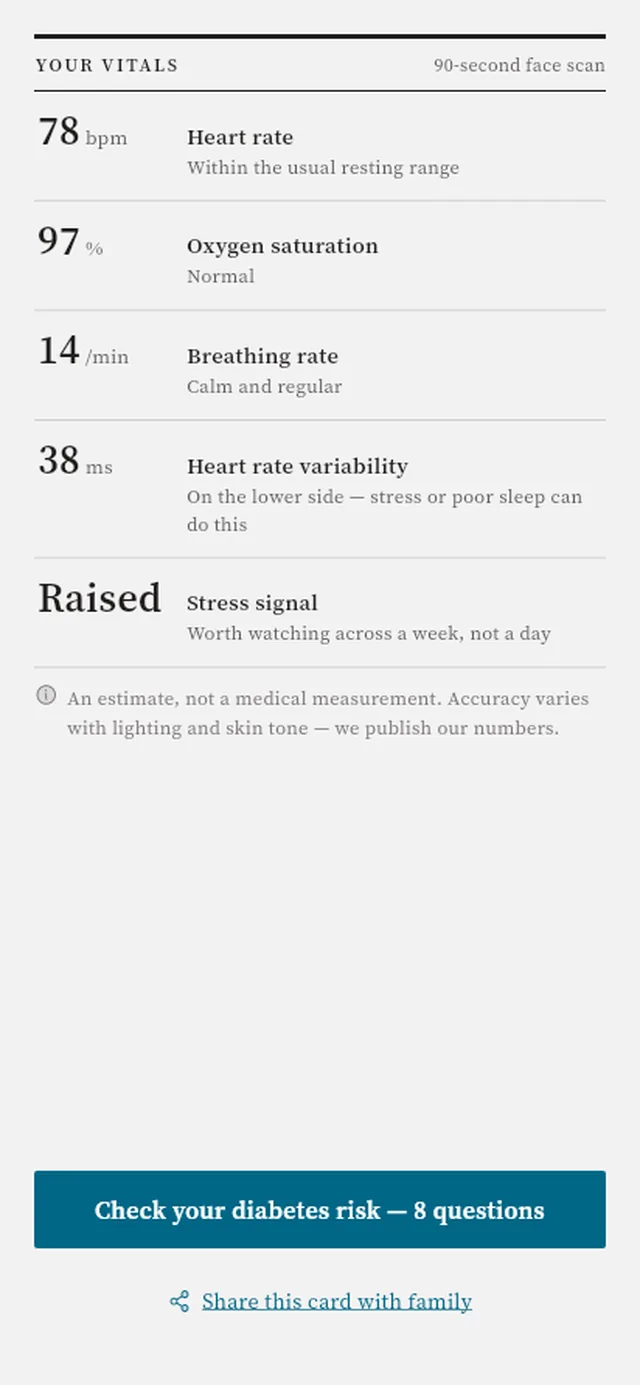
A 90-second face scan
Five signals, each with a sentence — and the words “an estimate, not a medical measurement” on the result itself.
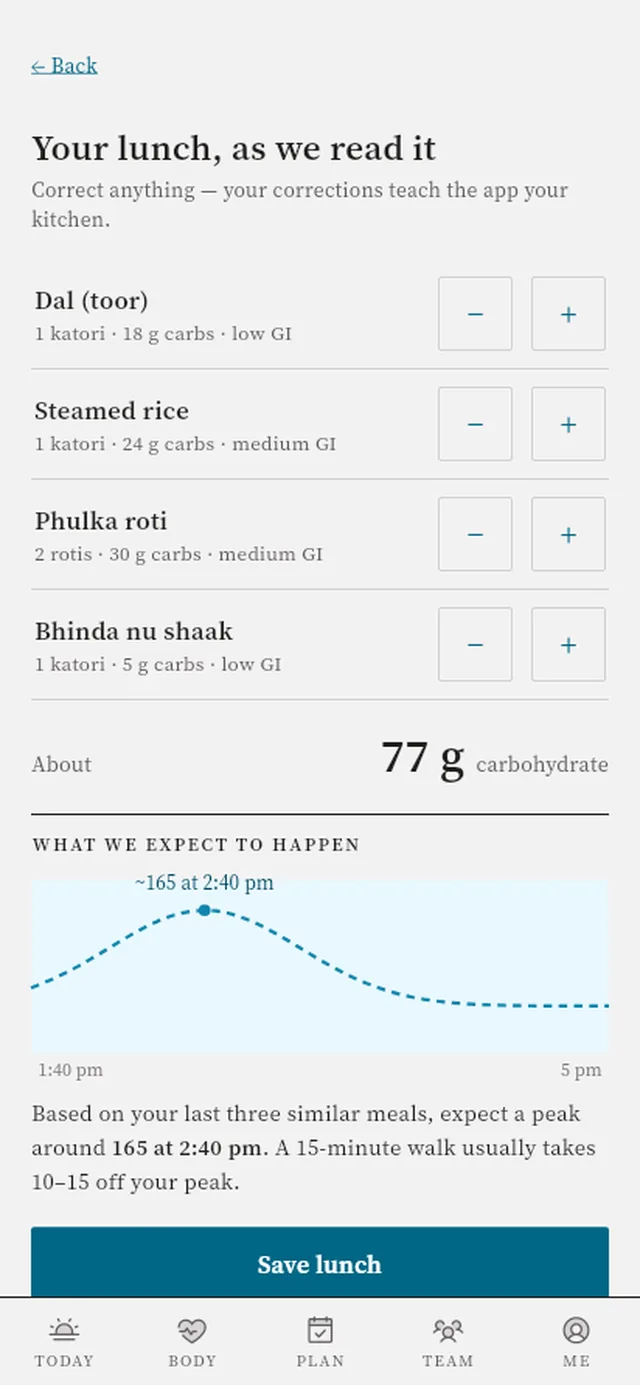
Photograph the thali
Portions in katori and roti, not grams. Then the curve it expects — so two hours later you can see whether it was right.
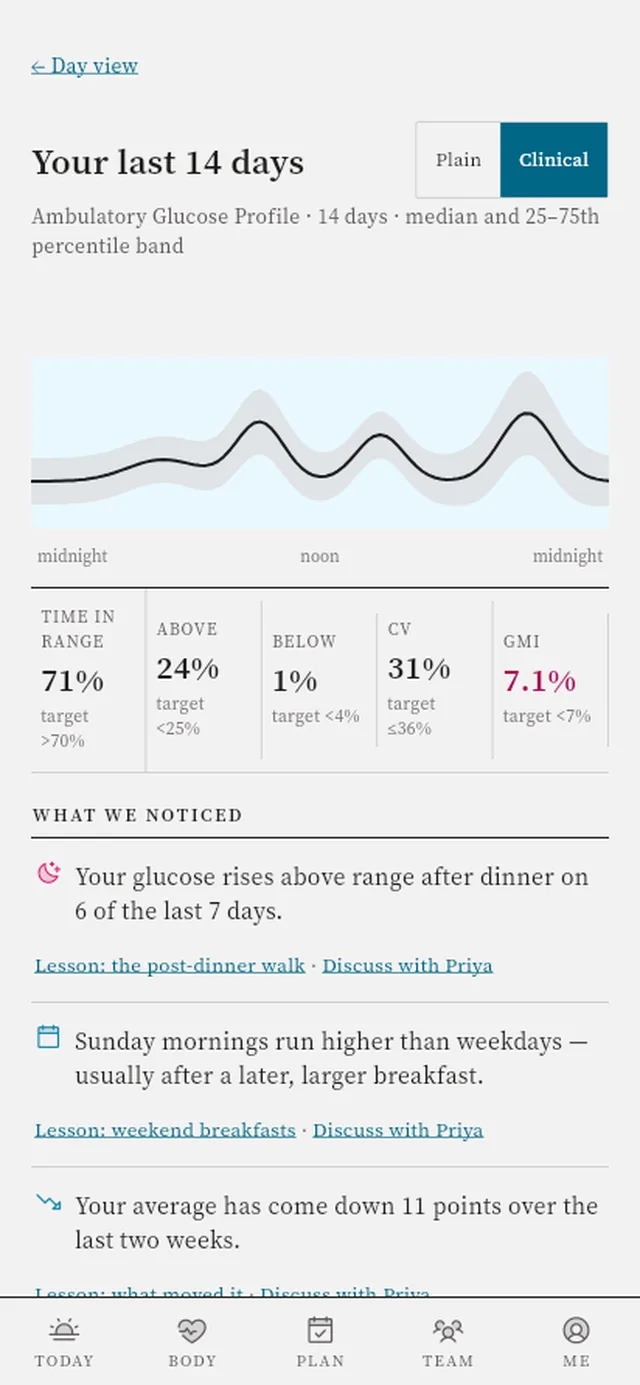
Fourteen days at a glance
The same ambulatory glucose profile your doctor reads, in plain language or clinical view.
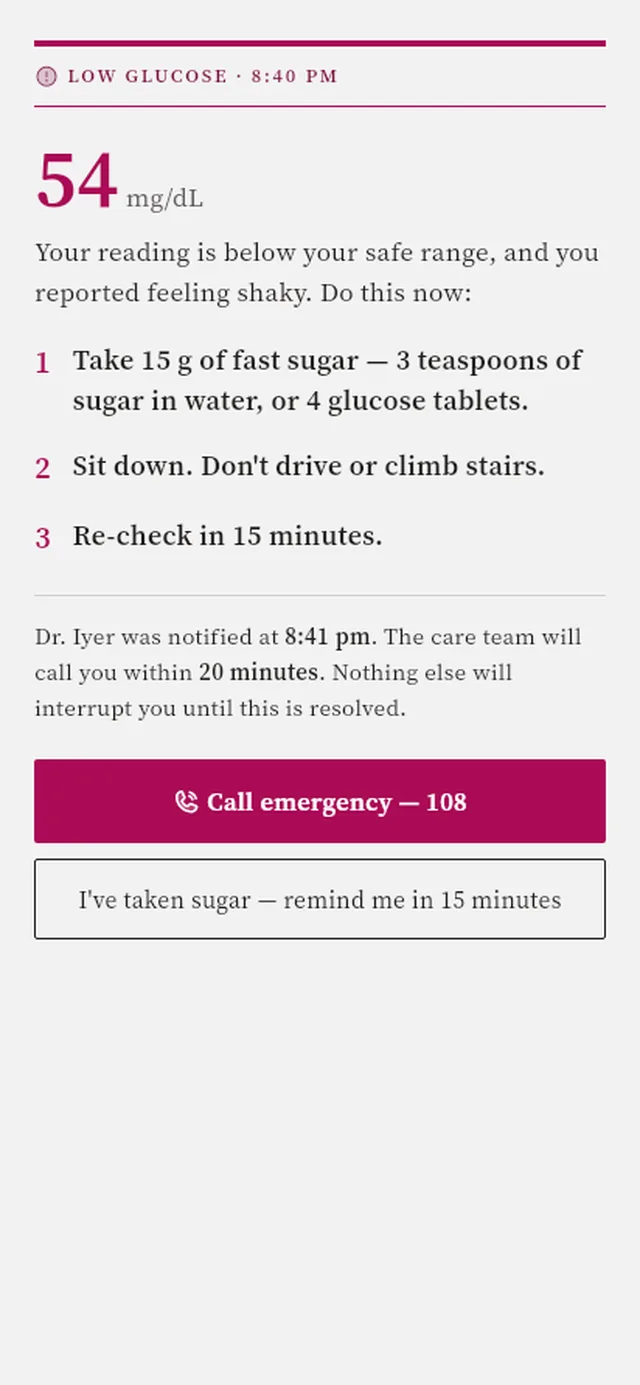
When glucose goes low
Everything else stops. Three steps in large type, a doctor notified, and a promised call time.
What a sensor lets you test
The same meal, on two different people.
Your dietitian changes one thing at a time and watches what your own body does with it — white rice against dalia, this week against last. That is an experiment with one participant: you. It is the difference between a food list written for everybody and a plan built from your own readings.
White rice — peaks higher, and sooner
Dalia — a later, lower rise that stays in range
Where the AI sits
Three assistants. Every one of them answers to a person.
AI vitals app
A guided face scan estimates five signals — heart rate, SpO₂, respiratory rate, stress and heart-rate variability — and flags exceptions for the care team to review.
Continuous visibility between scheduled consultations.
AI Rx intelligence
Protocol-led prescription decision support. The AI ranks suitable pathways; your doctor tallies, modifies and counsels.
Governed by a senior endocrinology advisory board.
AI diet intelligence
Condition-specific nutrition for cardiac, renal, retinopathy and diabetes profiles. A meal photo becomes a carb and GI estimate.
Governed by a senior dietitian advisory board.
AI proposes; qualified doctors and dietitians validate. Protocol governance, treatment decisions and escalation remain human-led.
Your care team
Four roles, defined by who carries the clinical authority.
Physician / RMO
Clinical authorityDiagnosis, medication decisions, contraindications, adverse-event review and high-risk escalation.
Red flags: same day
Dietitian + educator
Plan and safetyMedical nutrition therapy, regional meal plans, CGM interpretation, device technique, hypoglycaemia and sick-day education.
Initial plan: within 48 hours
Care coach
Behaviour executionWeekly goals, reminders, motivational support, food and activity logging, and adherence exceptions.
Early phase: 1–2 contacts a week
Coordinator + specialists
ContinuityAppointments, renewals, pharmacy coordination and referral closure to nephrology, cardiology, OBGYN or endocrinology.
Referrals tracked to closure
Clinical governance sits with an advisory board of senior endocrinologists, who set the protocols, the prescription rules and the escalation thresholds the team works to.
Which pathway is yours
We confirm the diagnosis first, then assign the safest objective.
Type 1 diabetes / LADA
Insulin-safety pathway
CGM or SMBG, a diabetes educator, and insulin–food–activity coordination.
No remission claim is made on this pathway.
High-risk or complex Type 2
Control and organ protection
Physician-led, with CGM where it is useful and a specialist dietitian when triggered.
The objective is safe control, not remission.
Remission-candidate Type 2
Intensive weight management
Medication change is made only by a physician, never by the app or the programme.
Eligibility is confirmed by a physician before any remission claim is made.
Programmes
Three ways in. Every one includes the digital care layer.
Core diabetes reversal
₹12,999
12 months
12-month Type 2 diabetes reversal programme.
- Physician-led pathway with three scheduled reviews a year
- Dedicated dietitian and a customised regional diet plan
- Continuous glucose monitoring and CGM pattern review
- Diagnostic tests — fasting, PP, HbA1c and the advanced diabetic panel
- Care coach, diabetes educator and personal yoga trainer
- 24×7 patient chatbot and the Shukra Fit app
GLP-1 assisted
₹15,999
4 months · ₹22,999 for 6 months
Clinically governed metabolic weight-loss pathway.
- Rx-only GLP-1 under physician governance
- Titration and adverse-event monitoring
- Protein-target and side-effect support from your dietitian
- Continuous glucose monitoring throughout
- 24×7 patient chatbot and the Shukra Fit app
Integrated plan
From ₹19,999
4 months
Diabetes reversal together with GLP-1 assisted weight loss.
- Everything in the reversal pathway
- Everything in the GLP-1 pathway
- One care team coordinating both
CGM + the Shukra Fit app
Precision feedback, care follow-up and 24-hour support. Included with every package.
Programme fee only — sensors beyond the first, medicines and lab tests beyond those listed are always billed separately, and we will say so again at checkout. GLP-1 medication is prescription-only and dispensed against a valid prescription.
Answers
The questions people actually ask.
If yours is not here, a care coordinator will answer it on your callback — including the ones where the answer is “this programme is not right for you”.
Can type 2 diabetes be reversed?
For some people with type 2 diabetes, yes — and the word has a precise meaning. Remission is an HbA1c below 6.5% for at least three months without glucose-lowering medication. It is not cure: diabetes can return, which is why at least annual monitoring continues either way. Whether you are a candidate is a decision a physician makes after assessing you, not something a programme can promise in advance.
What is a CGM, and why does the programme use one?
A continuous glucose monitor is a small sensor worn on the arm that reads your glucose through the day, instead of a few finger-pricks. It shows what your own body does after your own meals — which is how your dietitian can test one change at a time, such as white rice against millets, and see the answer for you rather than in general.
Do I have to take GLP-1 medication?
No. The core reversal programme does not include GLP-1. The GLP-1 pathway is a separate, prescription-only option for clinically supervised weight loss, and a physician decides whether it is appropriate for you. Titration and side-effect monitoring are part of that pathway.
I have type 1 diabetes. Can I join?
Yes, on the insulin-safety pathway — CGM or glucose monitoring, a diabetes educator, and coordination of insulin with food and activity. We make no remission claim on this pathway, because that is not what the evidence supports for type 1 diabetes.
Who changes my medicines?
A physician, and only a physician. The app, the coach and the dietitian never change a prescription. Many people on the programme do reduce medication over time, but that decision is always the doctor’s.
What does the face scan actually measure?
It estimates five signals from a 90-second scan — heart rate, oxygen saturation, breathing rate, heart-rate variability and a stress signal. An estimate, not a medical measurement. Accuracy varies with lighting and skin tone — we publish our numbers.
What happens in an emergency?
Severe or recurrent low glucose, ketones, vomiting or dehydration, pregnancy, acute illness, a medication side effect, or rapidly worsening glucose all get a same-day clinical response. The app routes anything urgent straight to a named doctor rather than answering it itself. For a medical emergency, call 108.
What is not included in the programme fee?
The programme fee covers the care. Sensors beyond the first, medicines and lab tests beyond those listed are billed separately, and we say so again at checkout rather than after.
Start here
Check if the programme fits you
Tell us how to reach you. A care coordinator calls within one working day, asks a few screening questions, and books you a seat on the next physician-led webinar. No payment at this stage.
- A physician confirms eligibility before you enrol — enrolment is provisional until then.
- We say so plainly if the programme is not right for you, and show the pathway that is.
- Your details are used to contact you about the programme. Nothing else, unless you ask.